
Streamer Fishing in 2025


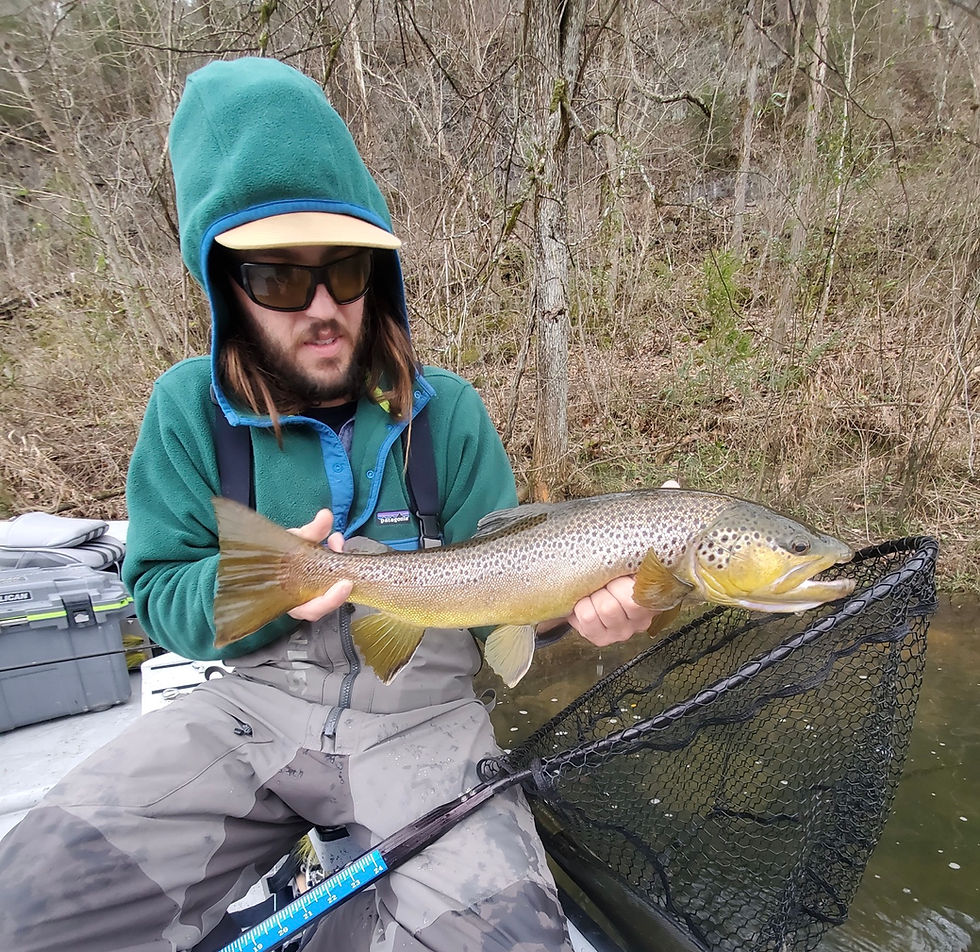
Streamer fishing on the White River is the big leagues of freshwater fly fishing! It is extremely technical to do properly and can be rewarding for those willing to put in the time and effort required. Throughout the winter, anglers from all over try their hand at casting big flies for world-class brown trout here on the White River, but few are consistently effective. Our so-called "streamer season" takes place from December to March (although it can be done any time of the year given the right conditions). The reason for this is that it coincides with the brown trout spawn. Generally speaking, the majority of our fish in the White River are actively spawning sometime in January or February, which has no doubt been trending later over the past few years. Throughout this article, I'm going to break down a winter of streamer fishing on the White River system and hopefully give you some tips and techniques to be successful.
Pre-Spawn
In my experience, December is prime time for pre-spawn brown trout fishing throughout the White River system. There will certainly be some fish spawning this time of year, but the vast majority will still be yet to spawn. During pre-spawn conditions, browns are inclined to eat a big meal for a few reasons. They become extremely territorial in and around the location where they will spawn. They are generally located adjacent to gravel and will be there for a couple of weeks, depending on conditions, before they inch up on the gravel and start making beds. The males and females both actively protect this area and can be triggered to chase a streamer very easily, but it's common to get 10 or more chases before you get a fish to actually eat during this time of year. I don't think they are necessarily "eating" the fly most of the time; they are more likely swiping at it to get it out of their zone. This is the reason it's important to use the correct hooks on your streamers. Just because the hook is big or says "streamer hook" on the package doesn't make it the right tool for the job. You're going to want a lighter wire hook that is sharp! If the hook is of thicker gauge wire, you're going to have to set it a lot quicker and harder for it to penetrate, and as I mentioned earlier, these trout aren't eating the fly every time. Very rarely do you see one flare its gills and open its mouth wide to eat your fly this time of year. They tend to track the fly for a ways and "nip" or slam into the side of the fly with closed mouths. Your odds of converting a fish chasing your fly into a fish in the net are greatly diminished during the pre-spawn period, more than any other time of year, if you're using the wrong hooks!
Because you tend to move more fish than you hook during this time, I almost look at it as a scouting mission for me as a guide. If I move a quality fish and don’t sting it or catch it, I will make a mental note of its location, the fly it moved on, and other variables that might help me put that fish in the net in the future. It might be on the next pass through or a month later, but having that brown trout’s "address" is just another piece of the puzzle that can help your success. Don't be discouraged about coming to the White River this time of year; there are many benefits to being out there during the pre-spawn, the biggest being the lack of fishing pressure. Sure, it might be cold, but we’re trout fishing in December in North America—guys in the Midwest or out West are begging for the conditions we have this time of year to chase trout. Trust me, it’s the whole reason I moved here almost a decade ago.
With the lack of fishing pressure this time of year, you get to present your fly to fish that have not seen a dozen streamers a day for weeks on end. This might just be a mental thing, but there is something about fishing for unpressured fish that makes this whole streamer game a little less frustrating at times!
Spawn/Post-Spawn
I'm lumping these two periods together. While we are targeting post-spawn fish this time of year, you will inevitably catch spawning fish. This might be a polarizing opinion, but I know for a fact that catching a spawning brown trout is not as detrimental to a fishery as people make it out to be. If it were, the White River would not be as prolific a fishery as it is! Thousands of trout get pulled off beds throughout the winter months on the White, whether you like it or not, and this has been going on since the fishery was created. Nothing new; the fishery is still here, and it’s still a top-tier brown trout fishery.
The theory is that brown trout are looking for a big meal to help replenish themselves after coming off the spawn. This is what makes this time period "prime time" for many anglers. To draw a parallel, this period is similar to the first week of November for a whitetail hunter—it's prime! We're looking at mid to late January through February here. In targeting these fish, I focus on softer moving water with seams to faster water in close proximity. These post-spawn fish will look for areas off the main "racetrack" of the river to relax and recuperate, but in areas where easy-to-eat baitfish will be available. This is an ambush point.
The techniques I utilize in these spots vary a little, but the constants are casting far enough across the seam without casting so far that your line gets immediately grabbed by the current, making it impossible to get rid of drag. For the retrieve, as soon as you cast, let the line shoot through your fingers; DO NOT DROP THE LINE! You need to strip the slack line that lands on the water as soon as possible. This is a crucial step in the process. Once you come tight to the fly, it can become situational, but most of the time, I like to have my anglers strip the fly into the seam and stop as soon as it hits that slightly faster water. This first big pause in the retrieve is a significant bite trigger! I've seen a lot of fish eat the fly right here. If they don't, fish the fly all the way back to the boat, incorporating pauses and applying action to your fly via the rod tip. This technique might feel like patting your head and rubbing your belly for beginning streamer anglers, but this is the way to do it. Once you get the hang of it, you'll never go back to the straight, old boring strip. This situation I just described is just one of many ways to target these brown trout with a streamer during this time of year.
Variables to Consider
The White River is the single most dynamic trout fishery in the world, and the big concrete wall at the top of the river is what creates it all. The Bull Shoals Dam is the reason this fishery exists, but the amount of water released from the dam can create and destroy bite windows in an instant. There are an infinite number of small nuances with water generation through the dam that can make or break you as a streamer angler.
In layman's terms: rising water is good, falling water is bad, and consistent water is workable. Minimum flow to about three units of water is "meh"—not ideal, but doable if we have to. This makes it challenging to plan a five-day streamer trip on the White, no doubt. If you're looking to book a trip in advance, these water flows are something we cannot control. We will fish through it and get what we get; you never know—it could be great! However, if you call me the night before trying to book a trip for the following day when we are forecasted for less than ideal water, I'm not going to take your money and take you out there if my expectations for the day are low.
If you do book a five-plus-day trip to make it happen with streamers, I recommend that duration for a few reasons. First, it usually takes some time for me to teach and instruct you to the level of being a proficient streamer angler. This is not flipping a bobber over the side of the boat and letting the bad side drag—it takes time to learn how to play this game. Indicator fishing is to checkers as streamer fishing is to chess. Don't be discouraged; you'll get there with enough time and guidance if you really want it.
Second, if you spend five eight-hour days on the White, you're going to hit some sort of bite window; you just have to capitalize on those opportunities. You're going to have downtime where you can’t buy a fish; you just have to grind through and wait for when the stars align. I like to describe streamer fishing as more akin to big game hunting. We're looking for a chance at a quality fish; you'll get more opportunities with a bobber and a nymph, plain and simple. I guide that too (gotta pay the bills), but if you want the highest of highs and lowest of lows, streamer fishing might be for you. There is nothing in the world like watching a trophy fish chase your fly down and nail it after you've spent countless hours grinding away.
Years ago, I had a client book me for three days of streamer fishing; he had never cast a sinking line before. No worries! I had fished with him before and knew he was a fairly proficient angler with a bobber—coachable, which is all you can ask for. Anyway, we put the boat in, gave him a little initial rundown on how this works, and started fishing our first bank of the day. We hadn't made it halfway down the bank when he stopped and said to me, "Man, I really thought we would have gotten one by now..." I realized that in our phone conversations, I hadn’t laid it out for him as I should have, which was a big learning experience for me.
Needless to say, it's easy to get wrapped up in reading and watching videos on streamer fishing the White and thinking there's a fish of a lifetime on every seam, grassy bank, or log. Many times there is, but getting those fish to eat can take time. So, I guess I'm saying that streamer fishing is not for everyone, but it's perfect for the patient angler who can't sit still. Nothing is more rewarding. To end that story, we went back to the truck, traded the streamer rods for nymph rods, and made a great trip out of it.
Another major variable is water temperature. This doesn’t necessarily impact whether we're going to go out and try to make a day of it as much as water flows do, but it does make a difference in where, what, and how we will fish. We can see water temperature changes from the 30s to the low 50s this time of year, and fish will behave differently across that spectrum. A degree of change can make all the difference between a slow day and putting fish in the net.
On the lower end of the water temperature scale, you're going to find lethargic fish—not only the trout but also the forage baitfish they prey upon. I’m not saying fish won’t eat, but you’ll need to do a few things to swing the odds in your favor. The first thing that is non-negotiable for me with lower water temperatures is to slow down your presentation. This usually means fishing with a heavier weighted fly and/or sinking line to ride as close to the bottom as possible because the baitfish will be hugging the bottom. They will also be moving very slowly, so your retrieve must coincide with what the baitfish are doing.
After your cast lands, let it sink to your desired depth while still applying action to the fly with your rod tip. As the fly stalls out, jerk the rod and strip in the slack. The fish will often eat during this stall. If the water temperature increases to around the mid-40s and higher, the fish will be more active and likely to eat a quicker-moving fly. This technique really shines in shallower water in this temperature range; you can cast over a shallow flat (1 to 4 feet deep), lock the rod in your armpit, and strip the fly with both hands as fast as you can. Fish will move off these flats and eat with reckless abandon! As long as the temperature is right, fishing this way is some of the most fun you can have with a streamer.
Thank you for reading this long-winded article about streamer fishing. It’s something I am truly passionate about, and it’s the main reason I moved here almost a decade ago. If you want to give it a shot this winter and learn a lot more, get a hold of me—I still have some open days that I’d like to spend on the water.


Comments